Sunday, 11 August 2013

6 – 10 August 2013 – Bagan, Myanmar

Located on the banks of the Ayeyarwady (Irrawaddy) River, the ancient city of Bagan has the highest concentration of Buddhist temples, pagodas, stupas and ruins in the world.

P1210728

The Bagan Archaeological Zone contains over 3,000 temples in a 26 square mile plain.

P1210842

P1210800

P1210780

 P1210868

P1210741

The temple site was too large to explore on foot so on one day we chose to explore the site on one of Bagan’s many horse carts.

P1210747 

One morning, we walked from our hotel to a quiet area of the site on the banks of the Irrawaddy River.  We didn’t see a single tourist but we saw several temples and villagers going about their daily lives.

P1210890

P1210888

P1210932

P1210918

Friday, 9 August 2013

3 - 4 August 2013 – Bago, Myanmar

Bago is a bumpy 2 hour train journey from Yangon.  The old British narrow gauge track meant that as soon as the train got up some speed it would shudder and rock from side to side.  We travelled past rice paddies full of water - it was very wet and in some spots there was water on both sides of the train tracks.

P1210497

Bago was a former capital of Myanmar and for its size had a large number of gaudy religious sites.

The feet of a reclining Buddha

P1210532

The Burmese python at the Snake Pagoda - purported to be the reincarnation of a famous monk. It was in snake heaven with devotees arriving to give it money, a dedicated chanter reading it poetry and a pond for an afternoon dip. On top of this it got regular chicken meals.

P1210546

Views of some of Bago’s many temples

P1210548

P1210562

P1210661

Temple art

P1210637

Meditating monk

P1210658

Nat (spirit) dancers

P1210594

One of the temples had a section dedicated to nat (spirit) worship - some animist belief predating Buddhism. It looked like a lot of fun with an orchestra of drums and cymbals creating a huge din while gaudily dressed dancers (transvestite/transgender) whirled around until they fell into a trance and had to be assisted to stand.  Meanwhile the surrounding crowd also danced and some also went into a trance-like state or had convulsions. The principal dancer wore a cow head headdress and the nat figurines in the background looked like people wearing cow head headdresses. At various intervals the monks came out and threw 50 Kyat notes (equivalent to 5 cents) into the air sending the crowd into a frenzy.

Tuesday, 6 August 2013

1 – 2 August 2013 – Yangon, Myanmar

Travelling to Myanmar feels like taking a step back in time.  In many ways little seems to have changed since British colonial times.

One of the many decaying moss-covered buildings built by the British

P1210314

Yangon Central Railway Station – with the original British narrow-gauge tracks

P1210373

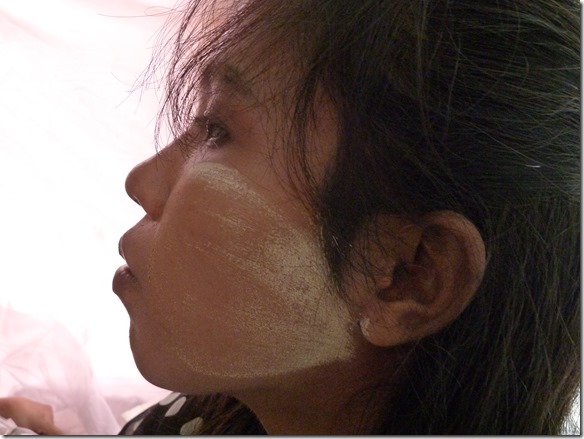
For the most part, the people of Myanmar stick to traditional customs and dress, with the men wearing the skirt-like longyi and women smothering their faces in thanakha (a yellow paste made from sandalwood – serving as sunblock and moisturiser).

P1210298

P1210361

During the time of the British Raj many Indians came to Myanmar, so there was a strong Indian feel to Yangon.

Traditional teashop offering – note the curry and samosas

P1210311

Betel nut (pan) packages for sale at 4 for 100 Kyat (US 10 cents)

P1210350 

When we got into our taxi at the airport. we noticed that the cars were all right hand drive vehicles and they drove on the right hand side of the road. The taxi driver told us that a previous general had become quite nervous about his waning power and had consulted an astrologer. The astrologer had advised him the only way to restore his power was to change the road system so he changed the traffic from the left hand side to the right hand side!

We also noted that there were no motorbikes in Yangon making it unlike any of the big cities in South East Asia.  Rumour has it that they were banned after a motorbike collision with a general’s car.

Myanmar’s version of a cycle rickshaw – the passengers sit back to back instead of side by side

P1210287 

We visited the Shwedagon Paya at dusk and stayed until the sun went down. It was really spectacular – an enormous gleaming gold stupa on an octagonal marble platform surrounded by hundreds of colourful temples, stupas and statues.

P1210417

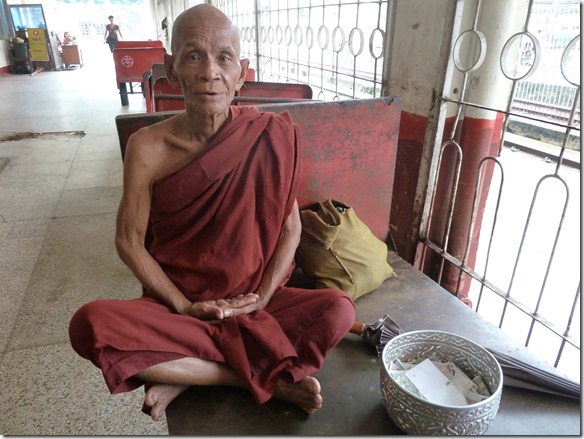
Unlike the rest of the monks in South East Asia, Burmese monks wear maroon (not saffron)coloured robes
P1210445

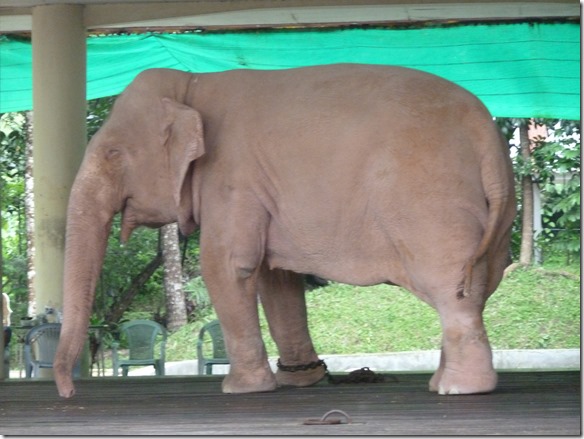
One of the three white elephants at the Hisn Hpyu Daw park
P1210470

The elephants are actually pink in colour and had been brought to Yangon by the military who regarded them as a good omen for the country. We felt that it was a bad omen for the elephants who were chained to the floor and were obviously unhappy and bored as they were rocking backwards and forwards to the extent of their short chain.

Fish for sale at a street market – perhaps the cigarettes are a sales gimmick?

P1210381

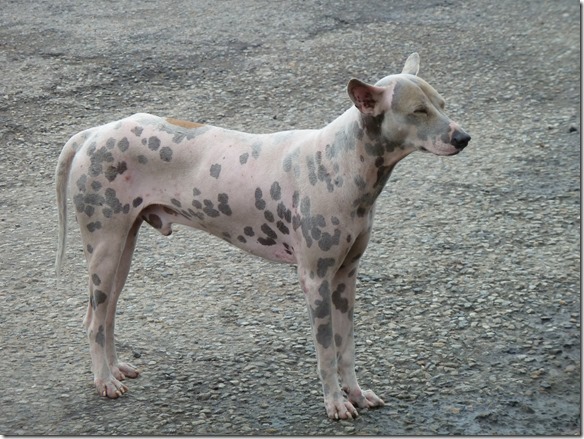
One of the many street dogs in Yangon – this spotted hairless dog was a particularly striking specimen
P1210369

Saturday, 3 August 2013

Saturday, 27 July 2013 – Lopburi, Thailand

Lopburi is one of Thailand’s oldest cities and was also a former capital of the country.  Lopburi is particularly famous for the monkeys (macaques) that overrun the Old Town.  When we arrived at Lopburi train station located in Old Town, there wasn’t a single taxi or tuk tuk to be found but there were packs of monkeys running around everywhere.

We stayed at a hotel in the New Town but even there we couldn’t escape the monkeys.  There were large monkey statues at the front of the hotel and also all around the pool and restaurant area. At first glance the restaurant and pool area looked really busy – until you looked closer and saw that it was the monkey statues wearing strange painted on outfits!!

P1210074

P1210067

P1210071

P1210192

We found the ruins at Lopburi a little disappointing in comparison to the other ruins that we had seen at Ayutthaya, Phanom Rung and Sukhothai, but we found the monkeys’ antics extremely entertaining.

P1210131

P1210107

P1210087

P1210109

P1210180

Wednesday, 24 July 2013 – Sukhothai, Thailand

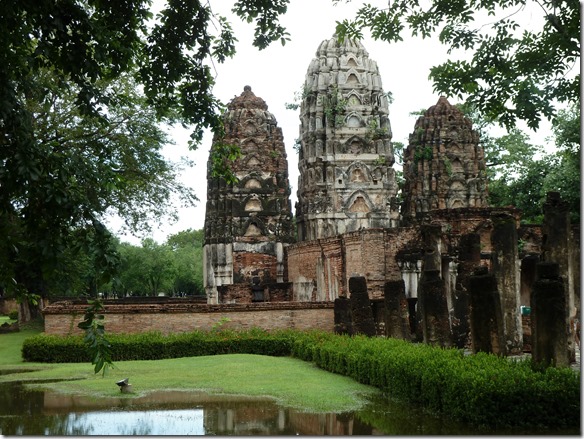
We visited the ruins of the ancient city of Sukhothai, which was the capital of Thailand during the 13th Century.

We started the day off in the Central Zone which had the highest concentration of ruins. Luckily for us it was overcast and cool and we were able to walk around comfortably for most of the morning admiring the ruins which were interspersed lotus filled lakes.

P1200855

P1200904

P1200906

P1200972

Some of the ruins were surrounded by moats and could only be reached by bridges.

P1200924

The most spectacular ruin in this zone was the Wat Mahathat with a large seated Buddha figure surrounded by pillars.

P1200923

After exploring the main sites in the Central Zone, we went to the Northern Zone. The most impressive ruin in this complex was the Wat Si Chum with a large seated Buddha peering through a narrow archway.

P1200962

Thursday, 1 August 2013

20 – 23 July 2013 – Chiang Mai, Thailand

Chiang Mai is one of the most culturally significant cities in northern Thailand.  We spent a relaxing few days in the walled historical old city which was surrounded by a moat.

P1200822

There were more than 30 temples within the walls of the city and we spent a pleasant couple of days wandering around the old city visiting temples.

 P1200581

P1200696

P1200807

We found this ruined stupa in the middle of a residential suburb outside the old city walls.

P1200833

Escaping from the heat Chiang Mai style!

P1200630